
More in Program Inventory
Out-of-School Time Program Inventory
Montgomery County's Department of Recreation provides a variety of out-of-school time (OST) programs for elementary, middle, and high school aged youth. In FY23, Recreation provided OST programming to over 20,000 youth across the County.
The following analysis takes a deep dive into the structured out-of-school time programming provided by the Department of Recreation in fiscal year 2023 along five key dimensions: participant age, program cost, program type, enrollment type, and program location. The goal of the analysis is to identify how well the current programming is meeting the needs of Montgomery County youth and families which will help inform future programming decisions.
The program inventory and analysis includes only a subset of all out-of-school time resources offered by the Department of Recreation. That subset includes structured OST programs like Excel Beyond the Bell and summer camps. Unstructured OST programs, like sports clinics and drop-in activities are not included in this analysis because of limitations around available data.
For a full list of Recreation programs available, please visit the Department of Recreation's website.

Program Inventory Analysis
Method
CountyStat examined the programs offered by Recreation in FY23 and categorized them along five dimensions: allowable age range to enroll; cost of the program, not including indirect costs that are covered by the department; the program type which can include summer camp, afterschool programs, etc.; whether the program is available for anyone who meets the age criteria to enroll or if it is restricted by a factor besides age; and where the program is located. Then, CountyStat analyzed the percent of program participants who participated in programs in each category.
Overall Findings
Overall, this analysis finds that along those five dimensions, structured OST programming in FY23 was well aligned with the needs of Montgomery County youth and families. Specifically, the analysis found that:
- Most participants were in age groups who need the most supervision outside of school hours.
- OST programs are very affordable for families compared to private offerings.
- Most participants were enrolled in programs during the summer when families need childcare solutions.
- Most participants were in open enrollment programming, ensuring that programs are accessible to all families.
- Programs are situated around the County, with the heaviest concentration of programs in the densest population centers.
The following sections provide a more detailed analysis of participation rates within each category.
Age Breakdown
Key Finding: Most participants in OST programming are in elementary or middle school, two groups who require more supervision than high school students outside of school hours.
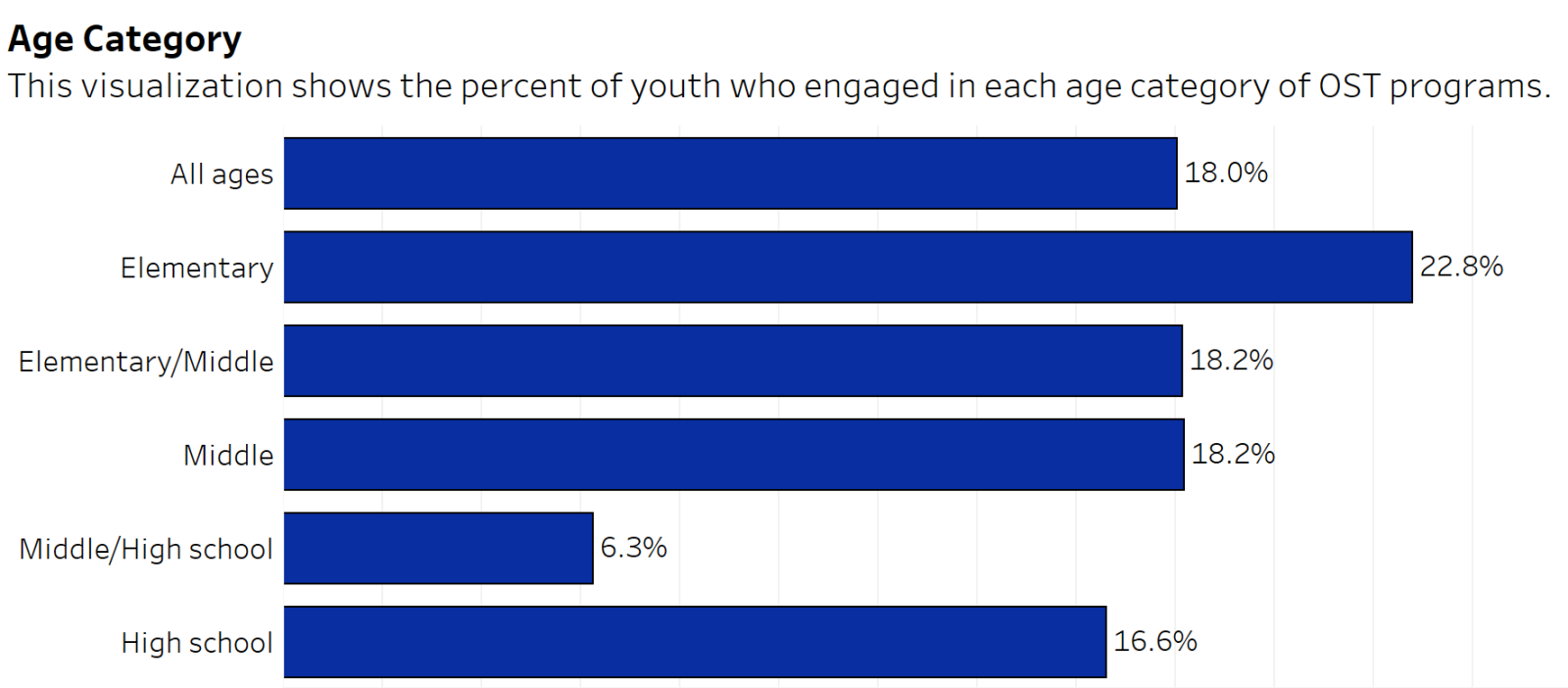
OST programs are offered for a wide range of ages. Programs start for youth as young as 5 years old and continue up to 18 years old (up to age 22 for youth with disabilities). Some programs are restricted to one age group while other programs allow enrollment of youth of multiple age ranges. In general, youth participation was approximately evenly split between programs that were offered for multiple age categories (42.5% of youth) and programs that were offered for specific ages (57.6% of youth).
-
Multiple age categories:
- 18% of youth participated in programs that served all ages
- 24.5% participated in programs for mixed aged groups
- 18.2% in programs for elementary or middle schoolers
- 6.3% in programs for middle or high schoolers
-
Single age categories:
- 22.8% of youth participated in programs for elementary schoolers
- 18.2% of youth participated in programs for middle schoolers
- 16.6% of youth participated in programs for high schoolers
The chart below shows that there is a relatively even dispersion of participation across the age categories, with a slight concentration of participation among the younger age groups. This is expected and appropriate, as younger children require more supervision and are more likely to be in programming during work hours than older youth. However, it is important to have opportunities for learning and recreation to youth of all ages which this analysis shows the Department is providing.
Cost Breakdown
Key Finding: The majority of OST participants engage in programs that are less expensive than the average weekly cost of afterschool programs in Maryland.
OST programs are a cost-effective option for Montgomery County families.
- 56% of youth participated in programs that had no cost to them or their families
- 37% of youth participated in programs that cost less than $125 for the duration of the program
On average, Montgomery County OST programs are more affordable than private camps or activities. The Afterschool Alliance found that families in Maryland spend an average of $122 per week on afterschool programming. Rec OST programs cost significantly less than that average. 93% of participants in Montgomery County spent $125 or less for the duration of their OST programs. For example:
- Camp Rec costs $60 for rising 1st through 5th graders attending summer school and provides 4 hours of engagement every day after school.
- Summer Fun Center costs $200 for middle or elementary school students to attend a traditional camp experience. It provides 10 hours of structured activities every day for 6 weeks during the summer. That is an effective cost of less than $1 per hour spent in programming.
A main driver of the affordability of OST programming is the indirect cost subsidies provided by the Department. Some programs with no cost to families are fully subsidized. Those that have a cost are still subsidized to an extent; for example, the department covers indirect costs like marketing and administrative program support (registration, etc.). Without this indirect subsidy, programming would cost more, limiting the program offerings to families who could bear a greater cost burden, or forcing the department to provide fewer options to families in the County.
In addition to indirect subsides, the Department also provides direct subsidies through a program called RecAssist. RecAssist is a financial assistance program that helps reduce the cost of program and membership fees for families who receive some form of public assistance. Families can receive up to $400 to apply toward a variety of Rec programming, including out-of-school time programs. More information about the Rec Assist program can be found here.
In FY23, families utilized over $240,000 in RecAssist funding to access Recreation programming. By FY24, that number had tripled and over $750,000 of funding was utilized for direct subsidies of Recreation programming. Note, these numbers include the subsidy applied to all programming, not just out-of-school time programs.
.png)
Program Type and Hours Breakdown
Key Finding: Most OST participants are involved in afterschool programming with the next largest segment in camps, covering times when families most need supervision for their children.
While OST programs are designed to provide learning and enrichment, they are also calibrated to meet a childcare need for working families. Most participants in OST programming in FY23 were enrolled in afterschool programs, followed by summer camps, two times when families need reliable childcare.
-
51% of participants engaged in afterschool programs
- 45.2% of students were in afterschool programs during the school year. In addition to educational and recreational activities, the afterschool programs also provide meals and transportation home for students
- 5.7% of students were in summer school wrap-around programs. After summer school wrap-around programs help families prevent summer learning loss while also giving students traditional summer camp enrichment. This program also provides access to transportation
- 27% of participants engaged in camps. Camps include outdoor adventure camps; contract and specialty camps that cover a range of topics like music, dance, and art; and Therapeutic Recreation, which provides appropriate and engaging activities to youth with disabilities.
- 15% of participants engaged in one day out of school programs. One day programs help support working families during the MCPS school year when school is out of session or has an early release.
Most afterschool program participants were enrolled during the school year. In addition to educational and recreational activities, the afterschool programs also provide meals and transportation home for students. A small subset of afterschool participants (5.7%) were enrolled in summer school wrap-around programs. After summer school wrap-around programs help families prevent summer learning loss while also giving students traditional summer camp enrichment. This program also provides access to transportation. Camps include outdoor adventure camps; contract and specialty camps that cover a range of topics like music, dance, and art; and Therapeutic Recreation, which provides appropriate and engaging activities to youth with disabilities. One day programs help support working families during the MCPS school year when school is out of session or has an early release.

Eligibility Breakdown
Key Finding: The majority of OST participants were engaged in programs with open enrollment.
Most OST programs are open to anyone who meets the age criteria to enroll. This is an important aspect of accessibility for families to choose from a wide variety of programming. Some programs, however, are restricted to students who are already affiliated with the MCPS location that hosts the program. These programs are typically part of the continuum of care. The goal of the continuum is to provide consistent and coordinated services to youth to keep them engaged in programming throughout their education. Despite limiting the accessibility of the program, the continuous engagement of youth at that location provides distinct benefits.
- 57% of participants were enrolled in programs that were open to anyone who met the age requirement.
- 43% of participants were enrolled in programs that were restricted to students at the MCPS location that hosted the program.
Open enrollment programs include Club Adventure, a monthly afterschool program held at local Recreation Community Centers; Kids Day Out/Teens Day Out, a daily activity for students on days when MCPS is not in session; and Summer Leadership Challenge, a leadership development program for high school students. Restricted enrollment programs include Excel Beyond the Bell, RecXtra, and RecZone which are open only to students who attend the particular school location and meet the age criteria.

Program Locations
Key Finding: OST programs are well situated in the County, covering the most populated areas as well as the majority of Equity Focus Areas.
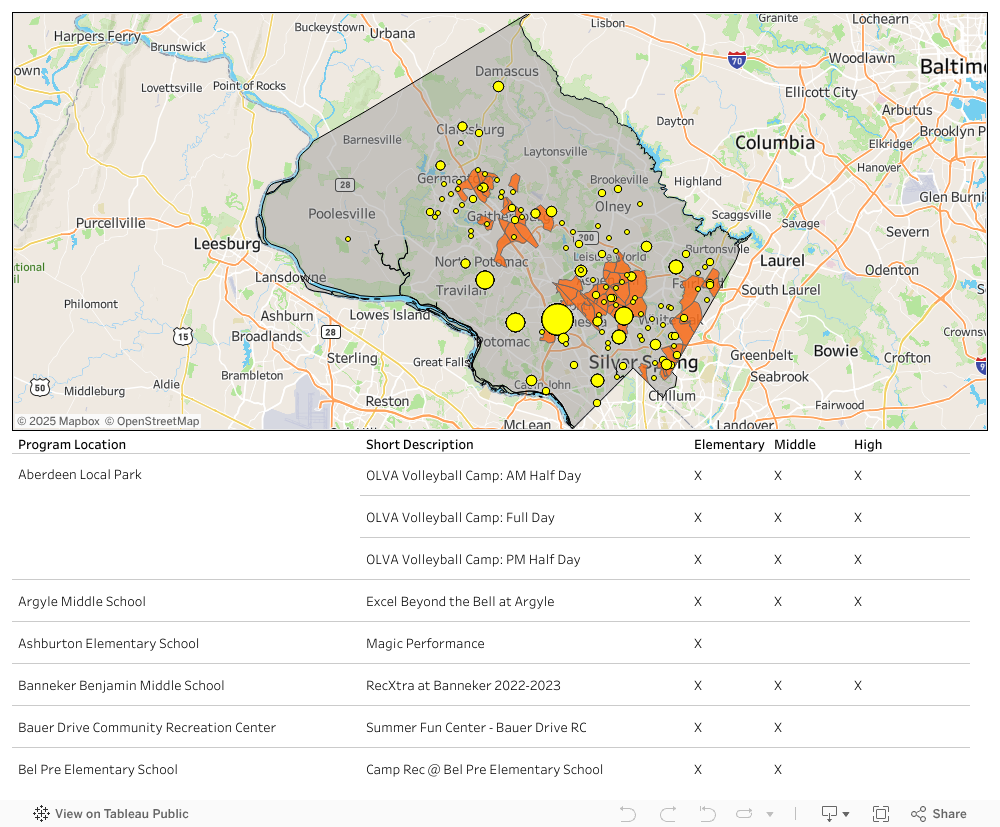
OST programs are located throughout Montgomery County, including in every Regional Service Area. Programs are offered as far north as Damascus and as far west as Poolesville. Most programs are clustered in the center of the County where the majority of the County’s population lives. Programs are offered within rec centers, elementary schools, libraries, and public parks. The map below shows the locations of OST Recreation programs offered in FY23.
While the Department does a laudable job of dispersing programs throughout the county to reduce travel burdens on families, they must operate within certain limitations that are outside their control. For example, Montgomery County Public Schools are renovated or refreshed on a certain time cycle. If a school is being refreshed, it cannot be used to host a Recreation program and the Department may have to choose a secondary location. The same is true of programs located in County buildings that might need renovations.
Highlight: Equity Focus Areas
The orange census tracts indicate Equity Focus Areas, or areas that have been highlighted as parts of the County that are characterized by high concentrations of lower-income individuals of color who may speak English less than very well. The County has identified these areas to try to ameliorate historic disparities that exist between them and other areas of the County. In FY23, 86% of Equity Focus Areas were within 1 mile of a Recreation OST program location. To read more about Equity Focus Areas, please click here.
The map below highlights the locations of programs in FY23. The size of the circle indicates how many programs are available at that particular location. Note that some programs may appear to be in the list more than once. Programs were included in the list if a person could individually register for each instance. For example, if an individual could separately register for a morning or an afternoon sessions of a sports academy, both the morning and the afternoon sessions are listed below.
Use the map below to explore program locations. The map can be filtered in two ways. Click on a yellow program dot to see the list of available programs at that location, in addition to the age groups served by each program. Click on the program location in the list to see that program’s yellow dot on the map. Click on either the dot or the program location again to undo the filtering.
Recommendations and Future Work
CountyStat applauds the work that the Department of Recreation has done to provide needed, engaging, and beneficial out-of-school time programming to the youth of Montgomery County and their families. Going forward, CountyStat recommends the following:
- Continue to work to expand access and utilization of RecAssist and identify any trends that may exist in subsidy utilization. The Department should continue to work to encourage families who are allocated RecAssist money to utilize it fully as well as to understand all of the potential areas in which it can be spent.
- Continue to assess program locations to ensure programs are accessible to the individuals who need them.
- Analyze program timing more closely to determine if there is a gap in available programming at the end of the summer. Many camps and programs end before the final weeks of August, leaving a potential gap in services for families who need programming before their children reenter school in the fall.