
Building Energy Performance Standards (BEPS)
 Building Energy Performance Standards (BEPS) are policies that establish performance levels for buildings and drive all buildings that BEPS covers to achieve these levels in the long-term with required progress at regular intervals in the interim. A BEPS sets a minimum threshold for energy performance for existing buildings, which are based on and measured against a building’s demonstrated energy performance, as shown in their benchmarking data.
Final regulations approved by County Council in February 2025 further outline key parameters of the BEPS program. View the Building Energy Performance Standards regulations.
For questions and guidance, please contact [email protected] or book a virtual appointment or site visit with DEP staff.
Policy Overview
The County has developed BEPS that aligns with goals for climate and racial/social equity, balances flexibility with immediate action, provides certainty and transparency for building owners and tenants, and spurs jobs and economic growth. The County’s BEPS Law incorporates the following components:
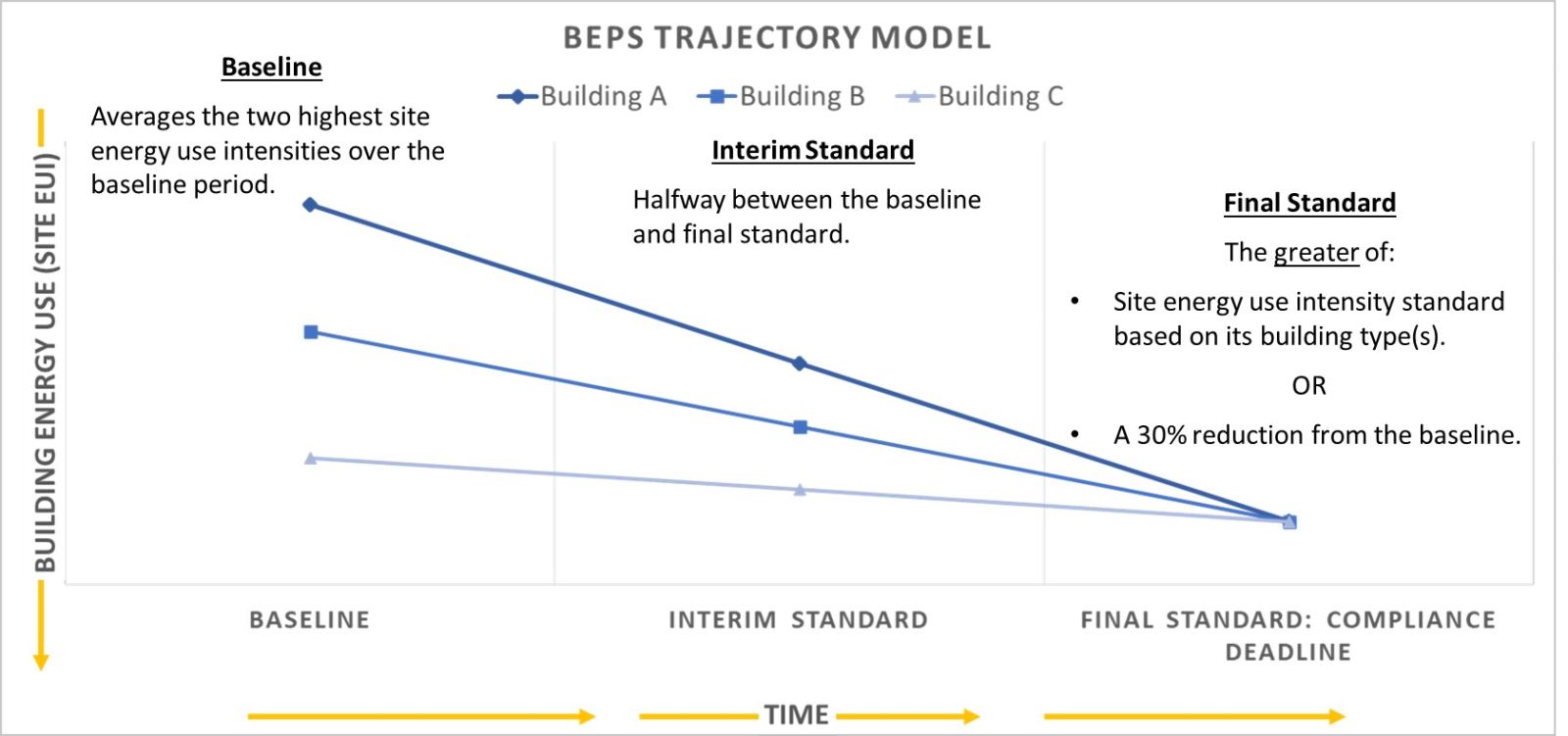
- After benchmarking for at least 3 years, each covered building receives a baseline averaging the 2 highest site energy use intensity (site EUI) over the baseline period.
- Each covered building is assigned a final performance standard based on the building type. Mixed-use buildings receive "area weighted" final performance standards that factor in the floor area associated with each property type in the building.
- The final performance standard for any covered building will not require a reduction of greater than 30% from the building’s baseline.
- After 5 years, buildings are evaluated as to whether they are meeting the interim target which is halfway between the baseline and final standard.
Performance Standards
Every covered building in Montgomery County 25,000 sq. ft. and larger has a final site energy use intensity (site EUI) standard that it much reach by that building’s final performance standard deadline (see Covered Buildings and Deadlines). Site EUI measures the energy use per gross square foot of building area each year. Each building’s final performance standard is based on the building's use-type as reported to DEP via energy benchmarking. View the final performance standard for each building type.
If a covered building consists of one building type, then its final performance standard is the final performance standard for that building type. Mixed-use covered buildings have an area-weighted final performance standard based on the gross floor area (GFA) assigned to each building type. Buildings with baselines more than 30% away from the building's final performance standard will instead receive a final standard that reflects a 30% reduction from the building's baseline.
In addition, every building has an interim performance standard that they must meet. This interim standard is halfway between the baseline and final standard. Each building's baseline and interim standards are unique to that building. Interim and final standard deadlines are based on the building's group (see covered buildings and deadlines).
You can look up each covered building’s baseline, interim, and final standards and deadlines in the Performance Requirements Look-Up Tool and search by address or Montgomery County Building ID.
Compliance Options
Covered buildings demonstrate compliance with the interim and final performance standards by reporting building energy use benchmarking data to DEP as required each year. Many buildings are already performing at or below their final performance standard. These buildings continue benchmarking as required each year. As long as the building’s performance remains below the interim/final standard at the deadline, the building will be considered in compliance with BEPS.
Owners of buildings with site EUIs above the interim or final standard have two options to comply with County BEPS:
Performance Path
DEP determines whether a building is meeting the performance standard by comparing the covered building’s performance to its interim or final performance standard at that building’s deadline. Performance is measured in normalized net site energy use intensity (NN EUI).
NN EUI is calculated by taking the building's weather normalized site energy use (including all energy used in the building for space heating, pumps and fans, space cooling, lighting, hot water heating, and other loads) minus the onsite renewable energy generation, parking energy use, and electric vehicle charging energy use and dividing by the building's gross floor area, as depicted below: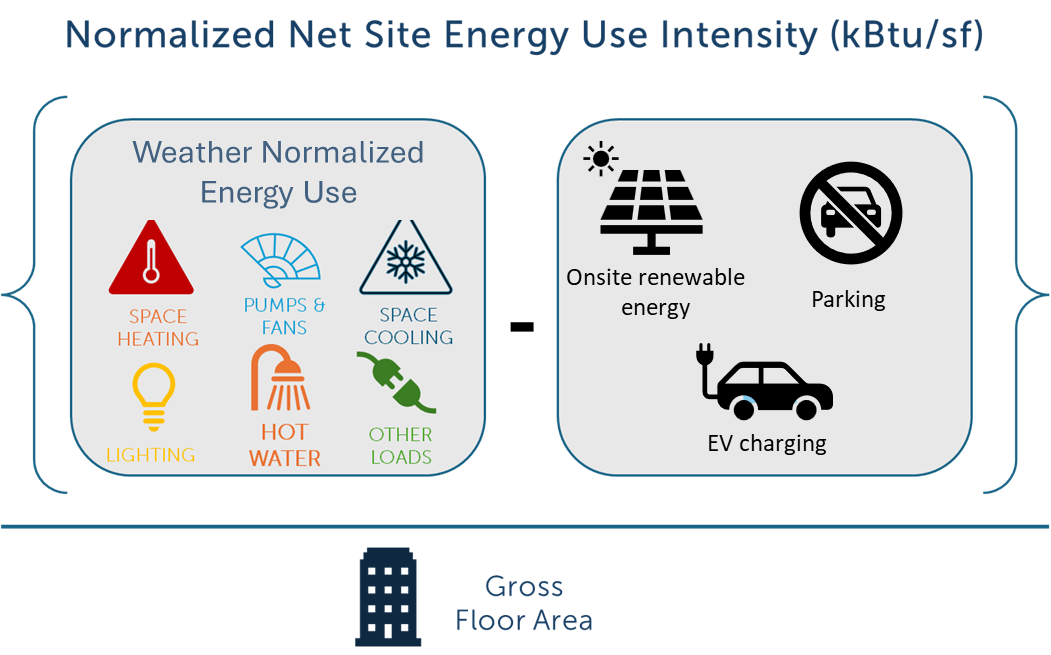
While BEPS prescribes an interim and final standard that each building must meet, it does not prescribe actions building owners must undertake to reach those standards. As such, owners have multiple strategies to reduce energy consumption to meet the interim or final EUI. Buildings also receive a renewable energy allowance for all onsite renewable energy as a “credit” towards the performance standard.
A covered building will be in compliance with BEPS if its performance is at or below the covered building’s interim or final performance standard at the building’s interim or final performance standard deadline.
Renewable Energy Allowance
Onsite renewable energy is provided a “credit” towards each building’s interim and final standard, whether used onsite or exported back to the grid and regardless of retention of renewable energy credits (RECs). This allowance applies to any building with an onsite renewable energy system and would apply to buildings with renewable energy installed and owned by the building owner, installed via a power purchase agreement, or that are hosts of community solar.
To receive a renewable energy allowance, onsite renewable energy must be reported via annual energy benchmarking.
Reference DEP's Technical Guidance on BEPS Performance Requirements for additional explanation of standards, calculations, and discussion about unique cases .
Building Performance Improvement Plan (BPIP) Path
Montgomery County also offers an alternative pathway referred to as the Building Performance Improvement Plan (BPIP) pathway. This pathway is designed for covered buildings where the measures required to meet the interim or final standard are not cost effective or when there are other circumstances outside the owner’s control.
If a covered building meets this criteria, this path requires an energy audit and assessment of electrification and renewable energy feasibility. Based on the results of the audit, the building owner must submit a retrofit plan that outlines cost effective energy improvement measures, along with the year(s) or qualifying event(s) that will prompt the implementation of each measure.
The BPIP must be submitted to the DEP no later than 90 days before the deadline for submitting documentation of compliance with interim or final standards . Buildings pursuing the BPIP pathway are still required to submit annual benchmarking and complete their retrofit plan but are not subject to meeting a site EUI performance target. To demonstrate compliance, building owners must also report annually on June 1st that the measures committed to under the retrofit plan were installed as planned. Plans are reviewed by the Building Performance Improvement Board.
-
Assess
The BPIP requires energy audit and assessment of equipment replacement, electrification feasilbility, and onsite renewable energy, done by a qualified auditor.
-
Plan
Create a retrofit plan identifying the cost-effective energy improvement measures and the year or qualifying event during which they will be done.
- Cost effectiveness is defined within the simple payback of each measure and is the lesser of the the lifespan of the measure, or, for specially designated buildings, 10 years.
- Specially designated buildings include:
- Local, small-business-owned buildings
- Non-profit-owned buildings
- Multifamily buildings subject to rent stabilization
- Common ownership communities
- Affordable housing buildings
-
Implement
Demonstrate ongoing compliance by reporting annually that the measures committed to in the retrofit plan were done per the schedule.
- Building owners meeting the actions and timelines in an approved Building Performance Improvement Plan will be considered to be in compliance with BEPS, regardless of the building's resulting performance.
-
Refile if needed
BPIP can be used for compliance with iterim and/or final standards. Measures with a simple payback of 5 years or less must be implemented before a subsequent BPIP is approved.
Reference DEP's Technical Guidance on BPIP Energy Audits and Retrofit Plans for requirements in scoping an energy audit, documentation, retrofit plans, cost effectiveness calculations, and more.
Resources
- Overview of Regulations: This document outlines final BEPS regulations and compliance options.
- Montgomery County Building Energy Performance Map: The map is an interactive and user-friendly tool to investigate current and historical benchmarking compliance status and energy performance data for each covered building.
- Performance Requirements Look-Up Tool: Provides an in-depth view to each covered building's current energy performance, baseline performance, and projected interim and final EUI standards based on proposed regulation.
- Montgomery County Green Bank Technical Assistance Program: Supports studies that inform and accelerate investment decisions in energy efficiency and renewable energy projects that improve building energy performance. Studies include ASHRAE Level I, Level II, Level III/ Investment Grade audits and/or targeted analyses into benchmarking, energy efficiency, renewable energy (e.g., solar PV), electrification, EV charging infrastructure, and resiliency measures. Prequalified service providers help property owners benchmark their buildings, integrate the County’s evolving Building Energy Performance Standards (BEPS) requirements into multi-year building improvement plans, and understand the potential for electrification.
- Get Help / Ask Questions: Book a virtual appointment or site visit with DEP staff. A free, onsite engineering consultation conducted by a DEP engineer is the simplest way to get started and provides clear, tailored BEPS recommendations. Book via the link or contact [email protected].
- DEP will provide updates on BEPS on this webpage and through its Commercial Energy News newsletter. If you have specific questions about BEPS, please email DEP.
- Consult the Energy Resource Hub or Commercial Energy Incentives pages for additional resources.
Upcoming Events
- Hidden Dollars in Your Building: Smart, Affordable Strategies for Equipment Upgrades
- Montgomery County Energy Benchmarking to help you prepare to submit your CY 2025 benchmarking report
- BEPS Compliance Options, Timelines, and Strategies - targeted specifically for Group 1 and 2 buildings currently more than 10% away from the interim standard
- April 28 - 29, 2026: Montgomery County Energy Summit.
State of Maryland Building Energy Performance Standards
The State of Maryland's benchmarking and building energy performance standards requirements cover most buildings in Maryland that are 35,000 square feet and larger (excluding the parking area). Owners of covered buildings under the regulation are required to annually benchmark and report their energy use and emissions starting in 2025. September 1, 2025 is the first benchmarking deadline. Between 2025 and 2030, building owners only need to submit their benchmarking report. Buildings will be required to meet greenhouse gas emissions targets that phase downward to zero between 2030 and 2040, or make an alternative compliance payment for emissions over the targets. For questions about state benchmarking and BEPS requirements, please contact [email protected].
As of October 1, 2025 buildings in Montgomery County will be exempt from the State's benchmarking and BEPS requirements. At that time, buildings covered by the County's benchmarking/BEPS program will only be subject to County requirements. Buildings in Montgomery County that would be exempt from State law (i.e., hospitals, private schools, buildings <35k sq ft) but still meet the County's coverage criteria will be subject to County benchmarking and BEPS requirements. Buildings not covered by or exempted from County BEPS will not be subject to either requirement. This follows legislation ( HB 49) passed by the Maryland General Assembly that will go into effect on October 1.
NEW: On August 14, 2025, MDE issued a compliance advisory - Buildings in Montgomery County that are in compliance with the Montgomery County Department of Environmental Protection (DEP) BEPS (i.e. have submitted a benchmarking report to DEP) will be treated as in compliance with Maryland BEPS for 2025 and their status on the BEPS portal will be updated to reflect this. Beginning October 1, 2025, buildings in Montgomery County will be waived from Maryland BEPS requirements but, if covered by the Montgomery County BEPS regulations, must comply with the county program.
Buildings covered by Maryland law can find the Unique Building ID (UBID) and additional instructions to report to MDE via ENERGY STAR Portfolio Manager can be found in MDE's BEPS Portal and Benchmarking Guide (PDF). Historic buildings, public and nonpublic elementary and secondary schools, manufacturing buildings, agricultural buildings, and federal buildings can all apply to be exempted via MDE's BEPS Portal. For questions about state benchmarking and BEPS requirements contact [email protected] .